
Grow Orders on Meesho 2026
Meesho seller growth guide · OTOECOM
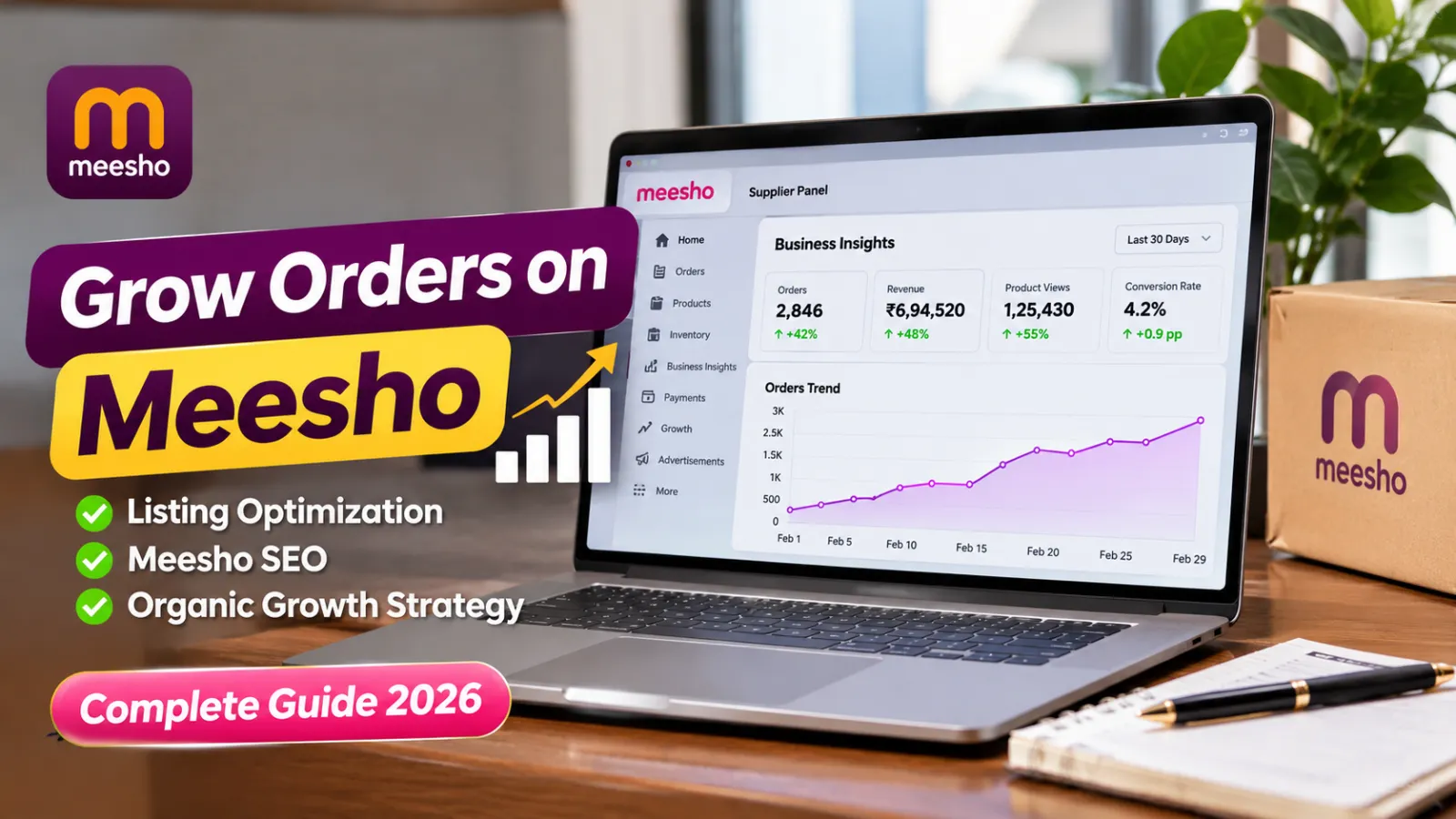
If you want to grow orders on Meesho, start by identifying why your products are not receiving enough relevant visibility, clicks or purchases. Uploading more catalogues alone is not a complete growth strategy. Sustainable sales come from selecting the right products, improving Meesho SEO, presenting an accurate catalogue, pricing competitively and delivering a reliable customer experience.
This practical guide explains how to increase orders on Meesho, improve organic product ranking, perform keyword research, optimize listings, reduce avoidable returns and build a repeatable 30-day seller growth system. It is suitable for beginners as well as existing sellers whose daily orders have stopped growing.
01 / Growth fundamentals
How to Grow Orders on Meesho: Start With the Seller Growth Funnel
Before changing your price, uploading another catalogue or investing in advertising, understand the journey from product discovery to a successful sale. A customer must first discover a relevant product, become interested in it, decide to order it and ultimately keep it. Each stage can restrict your business, and the solution depends on where the problem occurs.
For example, a catalogue that receives very little exposure needs a discovery and relevance audit. A catalogue that receives many views but few purchases needs a different investigation: product images, price, available sizes, reviews, delivery expectations or product details may be limiting conversion. A catalogue with strong orders and high returns requires quality and expectation management rather than more traffic.
Key principle: Do not optimize every catalogue in the same way. Identify the biggest bottleneck first, change a small number of relevant factors and measure the outcome before expanding the strategy.
Organic order growth is not about manipulating marketplace signals. It is about improving the usefulness and competitiveness of a product offer so that relevant customers are more likely to discover it, purchase it and remain satisfied with it.
02 / Account diagnosis
Why Are Your Meesho Orders Low or Not Increasing?
Many sellers experience slow sales despite having an active account and multiple live catalogues. However, a live catalogue does not guarantee traffic, a particular search position or orders. Begin by checking the live status, stock availability, category, price and any supplier-panel quality or policy messages. Compare recent data with a meaningful earlier period instead of judging the account based on one slow day.
| Seller problem | What to investigate | First action |
|---|---|---|
| Catalogue live but few views | Category relevance, product demand, stock, visibility status | Review attributes, recommendations and actual buyer search terms. |
| Views but few clicks | Main image, price position, search intent | Compare the product tile with relevant competing offers. |
| Clicks but few orders | Price, product details, sizes, customer trust | Improve the product page and test a profitable offer. |
| Orders suddenly decline | Stockout, seasonality, pricing changes, listing status, competition | Compare the date of the decline with account changes. |
| High orders but low profit | Settlement, packaging, refunds, returns and sourcing costs | Calculate contribution per placed order and per retained sale. |
| High customer returns | Wrong expectations, defects, sizing or packaging | Review return reasons at product and variant level. |
A useful account audit also separates newly launched catalogues from established ones. A new product may not have sufficient data for a meaningful comparison, while an older product might have a history that reveals changes in demand or competitiveness. Avoid making sweeping conclusions from a tiny number of impressions or orders.
03 / Product discovery
Meesho Product Research: Choose Products With Real Buyer Demand
Product selection is one of the most important decisions for any seller trying to increase sales on Meesho. A well-optimized listing cannot create unlimited demand for an unsuitable product. Research customer needs, competing offers and the cost of serving those customers before purchasing large inventory quantities.
A practical product research process
- Choose a category that matches your sourcing capability and product knowledge.
- Search specific product phrases in the Meesho app and review genuinely comparable offers, including pack size, material, variant and price.
- Read recent customer feedback to identify repeated complaints and unmet expectations.
- Use product recommendations in the Supplier Panel where available as an additional discovery input.
- Calculate landed product cost, packaging, expected settlement and the cost of returns before deciding the price.
- Start with a manageable test assortment and expand products that demonstrate repeatable demand and positive contribution.
For a women's kurti, compare products with a similar fabric, length, sleeve design, print and size range. A cotton daily-wear kurti should not be compared directly with a polyester festive kurta set simply because both appear in the same broad category. For household products, compare quantities, measurements, capacity and material quality.
Is there a clear customer need?
Look for relevant search results, recurring shopping use cases, buyer questions and a practical price range. Do not treat autocomplete as verified monthly search volume.
Can you fulfil the offer profitably?
Include sourcing, packaging, applicable taxes, marketplace deductions and expected return losses. A product can sell well and still lose money.
Meesho provides product and price recommendation tools for sellers. Use these alongside independent cost calculations, inventory decisions and category research. A platform recommendation is useful information, not a guarantee that every suggested product will sell profitably.
04 / Search relevance
Meesho Keyword Research: Find the Search Terms Buyers Actually Use
Keyword research helps sellers describe products in the language customers use when shopping. A strong Meesho SEO strategy begins with product relevance rather than repeating a high-volume phrase in every listing. Buyer intent can vary by product type, fabric, size, design, use case and price expectations.
Start with a core product term, such as women's kurti. Expand it using actual product attributes and natural customer language. Group similar terms together and prioritize phrases that accurately describe the item you are selling. Search suggestions, relevant competitor listings and product reviews can provide ideas, but they do not establish exact search volume or guaranteed ranking.
| Keyword group | Example phrases | Purpose |
|---|---|---|
| Primary product | Women printed kurti, women straight kurti | Identify the core item. |
| Material | Cotton kurti for women, rayon printed kurti | Match genuine fabric attributes. |
| Use case | Daily wear kurti, office wear kurti | Match relevant shopping needs. |
| Design | Floral print straight kurti, three-quarter sleeve kurti | Describe visual and construction details. |
| Specific intent | Blue printed cotton kurti for women | Target a narrower, relevant product search. |
Where should relevant keywords appear?
Use the strongest product phrase naturally in the title. Reinforce important information in the description and structured attributes, where supported. Select the correct category, material, size, colour and other required fields. Keep the wording consistent with the product images and actual item. If the item is not cotton, do not include cotton in the title just because the term appears popular.
There is no publicly established ideal keyword density that guarantees Meesho search ranking. Repeating the same keyword unnaturally can make a listing harder to read and can misrepresent the offer. Keyword research is an editorial and relevance tool, not a substitute for product quality, availability, competitive pricing and customer satisfaction.
05 / Catalogue SEO
Meesho Listing Optimization: Create Catalogues That Are Easy to Discover and Buy
A catalogue should answer the customer's practical questions before the order is placed. The title tells customers what they are looking at, attributes specify the product, images demonstrate its appearance and the description explains important details. When all four are aligned, customers can make a better purchasing decision.
Beautiful Latest Stylish Kurti
This title uses broad adjectives but does not clearly specify the fabric, fit, sleeve or print. It gives shoppers little information about the actual product.
Women's Blue Floral Cotton Straight Kurti, Three-Quarter Sleeves
This example names the item and useful attributes. Use it only when every stated detail is accurate and allowed by the category requirements.
Write useful product descriptions
Describe fabric, construction, dimensions, fit, closure, neckline, sleeve style, pack contents and care instructions where relevant. Mention limitations that could affect customer expectations, such as whether accessories shown in images are included. Do not add unrelated brand names or claim performance that the product cannot deliver.
Select accurate categories and attributes
Structured product fields can help the marketplace understand the item and help customers filter or compare it. Incorrect categories may expose products to the wrong audience or make it harder for relevant shoppers to find them. Review category-specific requirements and correct missing or inconsistent fields in the Supplier Panel. Avoid repeatedly recreating the same catalogue to chase visibility.
Keep a master product sheet containing SKU, catalogue ID, category, attributes, image version, price and last edit date. This reduces accidental changes, helps identify duplicated catalogues and allows you to compare performance before and after an optimization.
06 / Marketplace discovery
Meesho Algorithm and Organic Product Ranking: What Sellers Can Control
Meesho search and recommendations are not a single fixed leaderboard. Customers can receive different results depending on their search, preferences and marketplace conditions. The platform does not publish a complete ranking formula or fixed weights for every seller-side factor. Treat claims about a secret universal ranking trick with caution.
As a seller, focus on the factors you can manage: accurate product information, genuine relevance to the search, available stock, competitive offers, quality images and reliable fulfilment. Meesho's public seller resources describe tools for product selection, pricing and catalogue management; they do not promise a specific organic position after an individual change.
Relevance
Choose the right product type, attributes and language so that shoppers understand the item.
Offer quality
Provide accurate images, complete details, suitable prices and available variants.
Customer experience
Deliver what was promised and address repeated quality or return issues.
Check the performance of specific catalogue groups, not just the account total. A rank snapshot for one keyword can be informative but is affected by personalization and timing. Use consistent observation conditions and combine ranking observations with actual product views, orders and retained sales. Never rely on fake orders, fake reviews, artificial clicks or other attempts to manipulate marketplace systems.
07 / Visual conversion
Increase Meesho Product Visibility and Click-Through Rate With Better Images
Your main product image and price are often among the first things a shopper notices. A clear image should make the product recognizable at mobile thumbnail size. Avoid misleading edits, exaggerated scale, excessive text and accessories that may confuse buyers about what is included.
Product image optimization checklist
- Use a sharp, well-lit primary image with the actual product clearly visible.
- Show additional angles, close-up material details and relevant measurements.
- Represent colour and texture as accurately as possible.
- For apparel, provide a reliable size chart and show the fit where possible.
- For packs or kits, show the actual quantity and contents clearly.
- Follow current category-specific image policies and avoid unsubstantiated badges or promotional claims.
CTR means click-through rate: clicks divided by impressions, multiplied by 100. If these metrics are available at the same reporting level, compare them over a consistent period. Higher CTR does not automatically mean higher profit or even more purchases. An image that attracts the wrong audience may increase clicks while reducing conversion or causing returns.
Test one meaningful image change: Keep other major listing variables stable where practical. Compare CTR and orders after enough traffic has accumulated, and check returns before deciding which image performs better.
08 / Conversion
How to Increase Meesho Orders by Improving Conversion Rate
Conversion rate indicates how effectively visits or clicks turn into orders. For a seller, it can reveal whether interested shoppers are finding a sufficiently attractive and trustworthy offer. Before drawing conclusions, confirm how your available dashboard defines views, clicks and orders, because different metrics and time windows cannot be compared directly.
Check whether the offer answers common buyer concerns: Is the size available? Is the price reasonable for the material? Does the listing show the complete pack? Do images and descriptions agree? Are reviews highlighting a repeated issue? If the product has strong traffic but weak conversion, prioritize those questions instead of simply adding more keywords.
Illustrative order-growth formula
Orders = relevant impressions × click-through rate × order conversion rate.
This is a simplified funnel model, not Meesho's internal ranking formula. The following example is hypothetical and uses clicks as the conversion denominator.
CTR: 2% · 400 clicks
Conversion: 5%
CTR: 3% · 600 clicks
Conversion: 10%
Illustrative calculation only. It shows how different funnel improvements can change order volume at the same impression count. Actual seller results depend on demand, competition, stock, product quality and marketplace conditions.
The objective is to improve the complete customer journey rather than chase one metric. Track click-through rate alongside conversion, delivery outcomes and contribution. A catalogue that sells fewer units at a healthy margin may be more valuable than one producing many unprofitable orders.
09 / Pricing and profitability
Meesho Pricing Strategy: Grow Orders Without Destroying Profit
Pricing has a major practical influence on a customer's decision. A competitive price is not necessarily the lowest price on the marketplace. Compare offers of similar quality and specifications, then decide the minimum sustainable price based on your actual costs. Use the Price Recommendation tool where available, but do not accept every suggestion without checking the financial impact.
Calculate contribution before changing the price
| Illustrative cost item | Amount |
|---|---|
| Expected net settlement for a retained sale, before product and packing costs | ₹220 |
| Product sourcing cost | − ₹135 |
| Packaging and handling | − ₹15 |
| Allocated expected return and other variable losses | − ₹20 |
| Estimated contribution | ₹50 |
Hypothetical amounts, not Meesho fees or a guaranteed settlement. Use actual supplier-panel reports, applicable taxes and business costs. Avoid double-counting deductions already included in net settlement.
If you lower the price by ₹30 and the settlement falls by the same amount, the estimated contribution in this example drops to ₹20. You would need 2.5 times as many equivalent retained sales to earn the same total contribution, assuming all other costs remain unchanged. That is why order growth should always be evaluated together with profitability.
Review prices when sourcing costs, packaging, return behaviour or competing offers change. Use controlled tests and avoid frequent random adjustments that make performance difficult to interpret. A consistent price policy also makes inventory planning more predictable.
10 / Fulfilment
Inventory, Stock Availability and Dispatch Management
When a promising catalogue loses stock in popular sizes or colours, customers may be unable to buy the item they want. Maintaining the right inventory is therefore essential to convert demand into orders. Prioritize the products and variants with demonstrated retained sales rather than distributing stock evenly across every catalogue.
Track daily available stock, recent units sold and supplier replenishment lead time. An illustrative reorder point is average daily demand multiplied by replenishment days plus a safety buffer. For example, a variant selling five units daily with a six-day replenishment lead time and ten extra units of safety stock would have a reorder point of 40 units. Adjust the buffer for demand uncertainty, cash flow and storage limits.
Keep stock records accurate, process accepted orders according to the Supplier Panel requirements and pack the correct SKU. Where eligible, review faster dispatch options such as the Next Day Dispatch programme and decide whether your operations can consistently meet its requirements. Do not promise faster fulfilment if your sourcing or packing capacity cannot support it.
11 / Customer experience
Reduce Meesho Returns, RTO and Avoidable Order Losses
Growing placed orders is only one part of a successful ecommerce business. A customer return is different from a return to origin (RTO), where a shipment is not successfully delivered and is returned. Track both separately and review current platform settlement rules instead of assuming that every returned shipment has the same cost.
Customer returns
Check recurring issues such as size mismatch, incorrect item, damaged product, unexpected material or misleading pictures. Correct product details and fulfilment problems at SKU level.
RTO and delivery outcomes
Review shipment outcomes, inventory recovery and applicable costs in the Supplier Panel. Some delivery factors are outside the seller's control, so focus on accurate fulfilment and operational consistency.
For apparel, verify actual garment measurements instead of relying on inconsistent supplier labels. For fragile items, improve protective packaging and inspect goods before dispatch. For multipacks, use a packing checklist that records the correct number of items. Review returned inventory before selling it again and separate damaged or unsuitable units.
Meesho publishes information about shipping and returns in its seller resources. Check current category rules and actual charges, as policies and costs can change. Do not discourage legitimate customer returns or attempt to manufacture positive ratings. Build trust by delivering the advertised item and resolving genuine issues.
12 / Catalogue management
How to Scale Your Meesho Catalogues Without Random Uploads
Uploading useful new catalogues can expand your reach, but quantity alone is not a reliable growth system. A catalogue portfolio should serve distinct customer needs, price segments or genuine product variations. Organize it by performance so you can decide where to allocate time and inventory.
Proven catalogues
Maintain stock, investigate profitable variations and protect listing quality. Expand only when demand and fulfilment capacity support it.
Promising catalogues
Products with traffic but inconsistent orders. Diagnose the funnel and test one or two targeted changes.
Weak catalogues
Low relevance, poor economics or repeated returns. Fix the underlying issue, reconsider the product or stop replenishing it.
Maintain clear product records when adding colours, sizes and designs. Use valid variants and catalogue structures according to marketplace rules. Avoid duplicate uploads of the same offer, artificial variations or changes made solely to exploit perceived algorithm behaviour. A healthy portfolio should be manageable, differentiated and commercially justified.
13 / Analytics
Use Meesho Supplier Panel Analytics to Find Your Next Growth Opportunity
The Supplier Panel is a starting point for monitoring catalogue performance, orders, inventory, payments and operational issues. The tools and reports visible in your account may depend on category, account eligibility and platform updates. Export or record relevant metrics when possible so that you can track improvement over time.
| Metric | What it helps diagnose |
|---|---|
| Impressions or product visibility, if available | Whether a product is receiving discovery opportunities. |
| Views or clicks | Whether shoppers are showing interest in the listing. |
| Order conversion | Whether visits result in purchases. |
| Stock availability | Whether popular variants can be fulfilled. |
| Cancelled orders, returns and RTO | How much placed-order volume is lost before becoming retained sales. |
| Net settlement and contribution | Whether sales are financially worthwhile. |
Compare equivalent time windows, such as the most recent seven days against the preceding seven days, and also review a longer period to understand normal fluctuations. If festival demand or a major sale changes traffic, annotate that event in your records. A change in orders does not necessarily prove that a listing edit caused it.
Track a small set of meaningful KPIs rather than creating a complicated report that nobody reviews. Record the product ID, test date, edited field and baseline performance. Separate observations from conclusions, and avoid treating a single successful day as evidence of a permanent growth strategy.
14 / Execution roadmap
30-Day Action Plan to Grow Orders on Meesho
The following schedule provides a practical structure for new and existing sellers. It is an implementation plan, not a promise of a fixed number of orders within 30 days. Adjust the pace according to catalogue size, product availability and traffic volume.
Build your baseline
- Review live catalogue status and stock.
- Separate products into performance groups.
- Collect views, orders, returns and settlement data.
- Research product relevance, competitors and cost.
Improve the product offer
- Refine relevant titles and structured attributes.
- Correct descriptions and image inaccuracies.
- Review the main image and profitable price range.
- Resolve obvious fulfilment and quality issues.
Measure meaningful changes
- Run controlled image or price tests where practical.
- Monitor catalogue-level results and stock.
- Investigate products with clicks but weak sales.
- Record test dates and avoid premature conclusions.
Expand what works
- Replenish proven profitable variants.
- Evaluate genuine product expansion opportunities.
- Review delivery, returns and contribution.
- Plan the next month using accumulated evidence.
A daily routine for consistent seller growth
Every working day, first review order processing and stock alerts. Then investigate one meaningful catalogue issue instead of editing the entire account. Check recent return reasons and record any operational problems. Each week, review the results of changes and decide which products deserve additional inventory, improved images or a pricing test.
15 / Common mistakes
10 Mistakes That Stop Sellers From Growing Orders on Meesho
- Uploading without research: adding products before validating demand, quality and economics.
- Wrong category selection: presenting products to shoppers looking for something else.
- Keyword stuffing: using unrelated search phrases instead of helpful product details.
- Misleading photographs: increasing expectations that the actual product cannot meet.
- Copying competitor prices: ignoring differences in sourcing, packaging and settlement.
- Frequent uncontrolled edits: changing multiple variables and losing the ability to identify what helped.
- Ignoring popular variants: failing to replenish the products customers actually want.
- Focusing only on placed orders: overlooking returns, delivery outcomes and contribution.
- Expecting a guaranteed rank: treating personalized search results as a permanent position.
- Depending entirely on advertising: trying to buy more traffic for listings with weak relevance, conversion or economics.
Correcting these issues creates a more reliable foundation for organic sales. Paid advertising can be useful in some circumstances, but sellers should assess its cost and incremental contribution rather than use it to hide basic catalogue problems.
16 / Final checklist
Meesho SEO and Organic Order Growth Checklist
- Research a specific product and genuinely comparable offers.
- Use a relevant primary product phrase with accurate attributes.
- Check that catalogue category, title, description and images agree.
- Set prices using actual costs and expected contribution.
- Monitor the availability of high-demand variants.
- Review return reasons and correct repeated product issues.
- Compare consistent performance periods before changing strategy.
- Expand catalogues that demonstrate profitable, retained sales.
The most effective approach to grow orders on Meesho is to turn these activities into a repeatable operating process. Product research, keyword research, listing optimization and account analytics should inform one another, rather than function as separate tasks performed only when sales slow down.
17 / Seller questions
Frequently Asked Questions About Growing Orders on Meesho
How can I grow orders on Meesho without ads?
Improve product selection, catalogue relevance, accurate images, pricing, stock availability and conversion. Track return reasons and retained sales. Organic growth is possible, but results depend on competition, demand, account conditions and product performance.
How do I increase Meesho orders if my catalogue is live but has no sales?
Check stock, live status, product quality messages, category and relevance first. If the catalogue receives traffic, review the main image, price and product details. If traffic is limited, examine demand and discovery before changing the offer.
Does Meesho SEO help improve product ranking?
Accurate product information and relevant keywords can improve how shoppers understand a listing and help align it with relevant searches. Meesho does not disclose a complete ranking formula, so no SEO tactic can guarantee a specific position.
How many catalogues should I upload daily on Meesho?
There is no universal daily number that guarantees orders. Upload genuine products at a pace that allows accurate catalogue creation, quality checks, stock management and fulfilment. Prioritize relevant assortment expansion over duplicate or random uploads.
How can I increase product visibility on Meesho?
Start with the right category, accurate attributes, a relevant title, available stock and a competitive offer. Review supplier-panel recommendations and visibility or quality messages where available. Track actual discovery and order metrics rather than assuming a guaranteed ranking outcome.
Why have my Meesho orders suddenly decreased?
Investigate changes in demand, prices, available variants, listing status, competing offers and fulfilment outcomes. Compare dates with your account changes and allow for normal daily fluctuations. If there is a platform issue, use the Supplier Panel support process.
How do I find the best keywords for Meesho products?
Start with accurate product terms, search suggestions and genuine attributes, then study comparable listings and customer language. Select phrases that match the actual item. Do not treat autocomplete suggestions as exact search-volume measurements.
Can lowering prices increase sales on Meesho?
A more competitive price may help conversion, but it can also reduce contribution per sale. Calculate the expected net settlement and costs before testing a lower price. Measure both orders and profit rather than orders alone.
How can Meesho sellers reduce product returns?
Use accurate photographs, clear specifications, reliable measurements and correct pack contents. Inspect products, improve packaging and review repeat return reasons at SKU level. Follow marketplace policies and respect legitimate customer returns.
How long does it take to increase organic orders on Meesho?
There is no fixed timeline. Results depend on product demand, competition, available traffic and the changes being tested. Use consistent reporting periods and sufficient observations to evaluate whether a change is helping.
Which Meesho course should a beginner or existing seller choose?
Beginners can start with foundational account and catalogue training. Existing sellers may prefer advanced instruction in marketplace SEO, product research, conversion analysis and organic growth. Review the curriculum and choose according to your current skill level.
Learn with OTOECOM
Build a Practical Meesho Seller Growth System
Want to understand product research, keyword selection, catalogue optimization and organic marketplace growth in greater detail? Explore OTOECOM's Meesho Mastery and Meesho Advance courses. Learn with Vikram Singh and choose training that matches your business stage.
The aim is to develop a repeatable seller workflow rather than depend on shortcuts or guaranteed sales claims. Course details, availability and current pricing are available on the official course website.
Explore Meesho Seller CoursesAsk About TrainingLearn more about OTOECOM ecommerce training or browse our seller growth articles.
Useful Seller Resources
- Official Meesho Supplier portal — check current seller tools, catalogue requirements and account-specific information.
- Meesho Supplier Learning Hub — seller guidance on listing, pricing, inventory and business growth.
- Meesho shipping and returns guidance — consult current policies and applicable charges.
- Meesho Tech: competitive pricing for sellers — background on price recommendations.
This independent educational guide is published for marketplace sellers. Meesho is a third-party marketplace. Numerical scenarios in this guide are illustrative, not actual student results or promises of future performance.